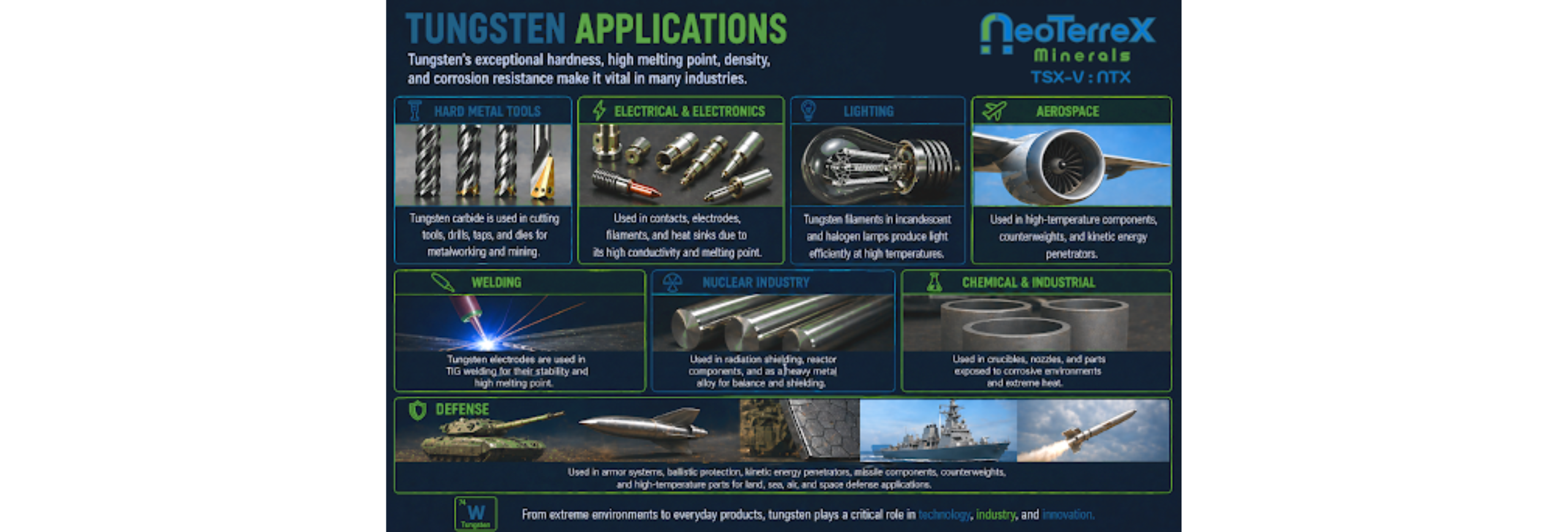

In a world hungry for critical minerals, tungsten is quietly emerging as a key player. Known for its exceptional hardness, density, and extremely high melting point, tungsten is essential to defense, aerospace, advanced manufacturing, mining, energy, and modern industrial applications. As geopolitical tensions continue to strain global supply chains and as tungsten is increasingly recognized as a critical mineral in many jurisdictions, there has rarely been a better moment to advance tungsten exploration.
NeoTerrex is not shying away from its rare earths assets, but management understands the company is in the envious position of having a prime Tungsten asset to advance with its Gravitas Project in Québec, and now it’s time to strike the iron, correction tungsten, while it is hot.
NeoTerrex’s Gravitas project is a mystery begging to be solved, both from a geological and historical standpoint. At the core of this mystery sits the Petosa Tungsten Zone (“PTZ”) which reportedly hosts some of the highest tungsten values documented in Québec, with historical grab samples returning values of up to 5.16% tungsten. Scheelite, the principal tungsten-bearing mineral identified on the project, has been observed in several locations within the project boundaries.
This is significant not only because of tungsten itself, but also because scheelite is considered an important pathfinder mineral for gold. Scheelite is known to occur in several major nearby gold-mining camps and deposits, including McWatters, Kerr-Addison, and Hollinger, suggesting that NeoTerrex is exploring highly prospective ground with potential beyond a single commodity.
Yet despite this potential, the project remains poorly understood. Hiding less than 100 metres from the road, the historical tungsten showing appears to have been largely lost to time and was not properly reflected in government databases until it was rediscovered by NeoTerrex geologists last year. Originally discovered in the 1930s during a period of intense regional gold exploration, the PTZ was further investigated by the federal government in 1942, when wartime demand for tungsten had sharply increased.What makes the opportunity particularly interesting is how little modern work has been completed. Aside from historical trenching and sampling, there is no clear evidence that the PTZ was ever drill-tested despite it being reportedly over 200 feet long and up to 17 feet in width. In practical terms, this means NeoTerrex is working on a historically mineralized system with strong grades, strategic-metal exposure, and meaningful exploration upside that has never received the level of systematic modern work it deserves.
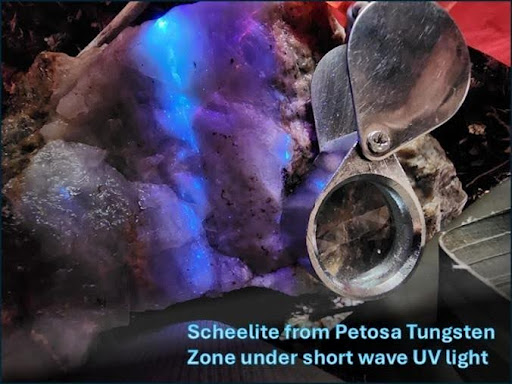
NeoTerrex’s team understands the opportunity and the timing. With permits in hand and local communities onboard, the Company is positioned to advance exploration at Gravitas this summer and begin answering the questions that history left behind. The next phase of work is expected to focus on exposing, mapping, sampling, and better defining the tungsten-bearing system before drilling.
NeoTerrex is not simply chasing an old showing. It is reopening a forgotten chapter of Québec’s critical minerals story at a time when tungsten matters more than ever. If there was ever a time to back tungsten, it is now — and Gravitas may be one of Québec’s more intriguing places to start.
CAUTIONARY STATEMENT REGARDING FORWARD-LOOKING STATEMENTS
This article may contain certain forward-looking information and statements, including, without limitation, statements pertaining to NeoTerrex’s future plans, objectives, or goals, as well as the potential of the Gravitas project and commencement date of the next phase of exploration on the project. All statements included herein, other than statements of historical fact, are forward-looking information and such information involves various risks and uncertainties. The Company does not undertake to update any forward-looking information except in accordance with applicable securities laws. There can be no assurance that such information will prove to be accurate, and actual results and future events could differ materially from those anticipated in such information. A description of assumptions used to develop such forward-looking information and a description of risk factors that may cause actual results to differ materially from forward-looking information can be found in the Company’s disclosure documents on the SEDAR+ website at www.sedarplus.
Written in partnership with Tom White